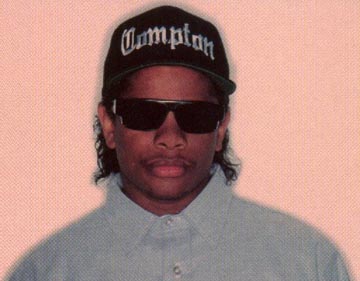
 Eric "Eazy-E" Wright was born September 7, 1964, in Compton, CA, a rough part of the Los Angeles metro area that N.W.A. would later make notorious. A high school dropout, Wright turned to drug dealing to support himself, and eventually used the profits to start his own rap label, Ruthless Records, with partner and music-business veteran Jerry Heller. E discovered a major performing talent in the D.O.C., and recruited Ice Cube and Dr. Dre to write songs for his stable of artists. When their composition "Boyz-N-the Hood" was rejected by Ruthless signee HBO, Cube, Dre, and E formed the first version of N.W.A. to record it themselves. Their first album, N.W.A. and the Posse, was released in 1987 and largely ignored; after a few tweaks of the lineup and the rough-edged subject matter, 1988's Straight Outta Compton made N.W.A. into superstars. E seized the opportunity to release a solo project later in the year, titled Eazy-Duz-It, which would be the only full-length album he would complete; it would sell well over two-million copies.
After Ice Cube's bitter departure from N.W.A. toward the end of 1989 (precipitated in part by Heller's business tactics), Eazy-E took over his not inconsiderable share of the rapping and songwriting duties, becoming the group's dominant voice on 1991's Efil4zaggin. His taste for cartoon-ish vulgarity began to undermine the claims of realistic inner-city reporting that the group had used to defend themselves. Disputes between the members led to N.W.A.'s breakup that summer, and a court battle between Ruthless and Dre's new label Death Row soon followed, with Eazy alleging that Death Row head Suge Knight had coerced Ruthless into releasing Dre from his contract. The case was eventually thrown out, but a bitter feud between Dre and Eazy raged for the next several years; Dre's seminal solo debut The Chronic made merciless fun of Eazy. E's 1992 solo EP 5150 Home 4 tha Sick sold well, but did little to dispel his increasingly cartoon-ish image; he found more success running the Ruthless label, with a roster that included Above the Law, N.W.A. bandmate MC Ren, the poorly received all-female group H.W.A. (Hoez With Attitude), and, eventually, the lucrative Bone Thugs-N-Harmony. Eazy addressed his feud with Dre on the 1993 EP It's On (Dr. Dre) 187um Killa, which famously included an actual photo of Dre wearing makeup and sequins during his World Class Wreckin' Cru days. Still, save for dissing Dre, Eazy didn't seem to have much to say, and despite healthy record sales, his artistic credibility was declining at an alarming rate. Eazy didn't help matters much when, in early 1993, he spoke out in support of Theodore Briseno, the only LAPD officer involved in the Rodney King beating to express displeasure; later in the year, he paid 2,500 dollars to attend a Republican fund-raiser, which his detractors saw as a further betrayal of his roots.
In early 1995, Eazy entered the hospital with respiratory difficulties, believing he had developed asthma. The diagnosis was far more serious: he had contracted AIDS. Eazy announced his plight to the public shortly thereafter, winning admiration for his straightforward attitude. Sadly, just a few weeks later, on March 26, 1995, the disease claimed his life. The record he had been working on, Str8 Off tha Streetz of Muthaphukkin Compton, was released posthumously (in unfinished form) later on in the year. In 2002, on the seventh anniversary of his death, some previously unreleased material from the Ruthless vaults was released as the EP Impact of a Legend, which was accompanied by a DVD.
|
|
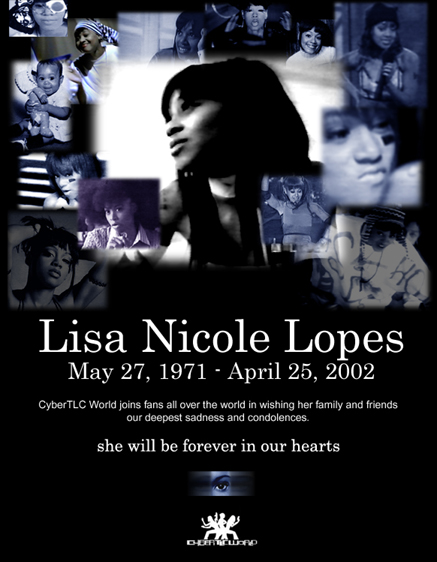 Lisa Nicole Lopes aka "Left Eye"
May 27, 1971 - April 25, 2002
Born in Philadelphia on May 27, 1971, Lopes formed TLC with Thomas and Watkins in 1992. Following the release of their debut album, Oooooooh...On the TLC Tip, the Atlanta-based trio achieved megastardom with their multiplatinum-selling album CrazySexyCool, which spawned the hit ballad "Waterfalls" as well as an accompanying multimillion-dollar video that won four MTV Video Music Awards.
|
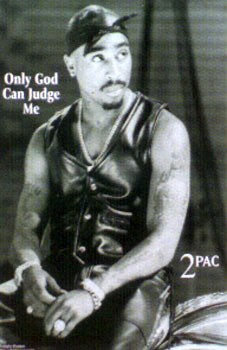
Tupac Shakur became the unlikely martyr of gangsta rap, and a tragic symbol of the toll its lifestyle exacted on urban Black America. At the outset of his career, it didn't appear that he would emerge as one of the definitive rappers of the '90s he started out as a second-string rapper and dancer for Digital Underground, joining only after they had already landed their biggest hit. But in 1992, he delivered an acclaimed debut album, 2Pacalypse Now, and quickly followed with a star-making performance in the urban drama Juice. Over the course of one year, his profile rose substantially, based as much on his run-ins with the law as his music. By 1994, 2Pac rivaled Snoop Doggy Dogg as the most controversial figure in rap, spending as much time in prison as he did in the recording studio. His burgeoning outlaw mythology helped his 1995 album Me Against the World enter the charts at number one, and it also opened him up to charges of exploitation. Yet, as the single "Dear Mama" illustrated, he was capable of sensitivity as well as violence. Signing with Death Row Records in late 1995, Shakur released the double album All Eyez on Me in the spring of 1996, and the record, as well as its hit single "California Love," confirmed his superstar status. Unfortunately, the gangsta lifestyle he captured in his music soon overtook his own life. While his celebrity was at its peak, he publicly fought with his rival the Notorious B.I.G., and there were tensions brewing at Death Row. Even with such conflicts, however, 2Pac's drive-by shooting in September 1996 came as an unexpected shock. On September 13, six days after the shooting, Shakur passed away, leaving behind a legacy that was based as much on his lifestyle as it was his music.
The son of two Black Panther members, Tupac Amaru Shakur was born in New York City. His parents had separated before he was born, and his mother moved him and his sister around the country for much of their childhood. Frequently, the family was at the poverty level, but Shakur managed to gain acceptence to the prestigious Baltimore School of the Arts as a teenager. While he was at the school, his creative side flourished, as he began writing raps and acting. Before he could graduate, his family moved to Marin City, California, when he was 17 years old. Over the next few years, he lived on the streets and began hustling. Eventually, he met Shock-G, the leader of Digital Underground. The Oakland-based crew decided to hire him as a dancer and roadie, and as he toured with the group, he worked on his own material. 2-Pac made his first recorded appearence on the group's spring 1991 record This is an E.P Release, and he also appeared on their second album, Sons of the P. The following year, he released his own debut, 2Pacalypse Now. The album became a word-of-mouth hit, as "Brenda's Got a Baby" reached the R&B Top 30 and the record went gold. However, its blunt and explicit lyrics earned criticisms for moral watchdogs, and Vice President Dan Quayle attacked the album while he was campaigning for re-election that year.
Shakur's profile was raised considerably by his acclaimed role in the Ernest Dickerson film, Juice, which lead to a lead role in John Singleton's Poetic Justice the following year. By the time the film hit theaters, 2-Pac had reased his second album, Strictly 4 My N.I.G.G.A.Z., which became a platinum album, peaking at number four on the R&B charts and launching the Top 10 R&B hit singles "I Get Around" and "Keep Ya Head Up," which peaked at number 11 and 12 respectively on the pop charts. Late in 1993, he acted in the basketball movie Above the Rim. Although Shakur was selling records and earning praise for his music and acting, he began having serious altercations with the law; prior to becoming a recording artist, he had no police record. He was arrested in 1992 after he was involved in a fight that culminated with a stray bullet killing a six-year-old bystander; the charges were later dismissed. 2-Pac was filming Menace II Society in the summer of 1993 when he assaulted director Allen Hughes; he was sentenced to 15 days in jail in early 1994. The sentence arrived after two other high-profile incidents. In October of 1993, when he was charged with shooting two off-duty police officers in Atlanta. The charges were dismissed, but the following month, he and two members of his entourage were charged with sexually abusing a female fan. In 1994, he was found guitly of sexual assault. The day after the verdict was announced, he was shot by a pair of muggers while he was in the lobby of a New York City recordings studio. Shakur was sentenced to four and a half years in prison on February 7, 1995.
Later that month, Tupac Shakur began serving his sentence. He was in jail when his third album, Me Against the World, was released in March. The record entered the charts at number one, making 2-Pac the first artist to enjoy a number one record while serving a prison sentence. While he was in prison, he accused the Notorious B.I.G., Puffy Combs, Andre Harrell and his own close friend Randy "Stretch" Walker of orchestrating his New York shooting. Shakur only served eight months of his sentence, as Suge Knight, the president of Death Row Records, arranged for parole and posted a $1.4 million bond for the rapper. By the end of the year, 2-Pac was out of prison and working on his debut for Death Row. On November 30, 1995 the one-year anniversary of the New York shooting Walker was killed in a gangland-styled murder in Queens.
2-Pac's Death Row debut, All Eyez on Me, was the first double-disc of original material in hip-hop history. It debuted at number one upon its February release, and would be certified quintuple platinum by the fall. Although he had a hit record and, with the Dr. Dre duet "California Love," a massive single on his hands, Shakur was beginning to tire of hip-hop, and started to concentrate on acting. During the summer of 1996, he completed two films, the thriller Bullet and the dark comedy Gridlock'd, which also starred Tim Roth. He also made some recordings for Death Row, which was quickly disintegrating without Dr. Dre as the house producer, and as Knight became heavily involved in illegal activities.
At the time of his murder in September 1996, there were indications that Shakur was considering leaving Death Row, and maybe even rap, behind. None of those theories can ever be confirmed, just as the reasons behind his shooting remain mysterious. Shakur was shot on the Las Vegas strip as he was riding in the passenger seat of Knight's car. They had just seen the Mike Tyson-Bruce Seldon fight at the MGM Grand, and as they were leaving the hotel, 2Pac got into a fight with an unnamed young black man. It has been suggested that this was the cause of the drive-by shooting, and it has also been suggested that Knight's ties to the mob and to gangs were the reason; another theory is that the Notorious B.I.G. arranged the shooting as retaliation for 2Pac's comments that he slept with Biggie's wife, Faith Evans. Either way, Shakur was shot four times and was admitted to University of Nevada Medical Center. Six days later, he died from his wounds.
Hundreds of mourners appeared at the hospital upon news of his death, and the entire entertainment industry mourned his passing, especially since there were no leads in the case. Many believed his death would end the much-hyped East Coast/West Coast hip-hop rivalry and decrease Black-on-Black violence. Sadly, six months after his death, his rival the Notorious B.I.G. was murdered under similar circumstances. As Shakur's notoriety only increased in the wake of his death, a series of posthumous releases followed, among them Don Killuminati: The 7 Day Theory (issued under the alias Makaveli), One Million Strong, and 1999's Still I Rise. Rose That Grew From Concrete followed a year later; Until the End of Time appeared in early 2001.
|
|
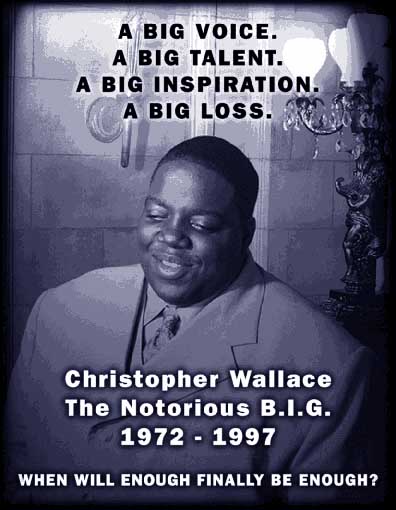 The Notorious B.I.G.
The Brooklyn-born rapper the Notorious B.I.G. (born Chris Wallace) first gained attention for his work on Mary J. Blige's "What's the 411?" When he delivered his debut album, Ready to Die, in 1994, it became one of the most popular hip-hop releases of the year. In June of 1995, his single "One More Chance" debuted at number five in the pop singles chart, tying Michael Jackson's "Scream/Childhood" as the highest debuting single of all time. Ready to Die continued to gain popularity throughout 1995, eventually selling two million copies. With its success, the Notorious B.I.G. became the most visible figure in East Coast hip-hop, and he became a target in the heated feud between the two coasts; especially as he and Tupac Shakur, a former ally, became vicious rivals.
As the Notorious B.I.G. was preparing his second album, Shakur was shot and killed in Las Vegas. Many in the media speculated that Biggie's camp was responsible for the shooting, accusations that he and his producer, Sean "Puffy" Combs, vehemently denied. However, the wheels had been set in motion for another tragedy. Early on the morning of March 9, the Notorious B.I.G. was returning to his hotel in Los Angeles after a Soul Train Award party when another car pulled up aside his car and opened fire, killing him instantly. Shakur had been killed just six months earlier.
The Notorious B.I.G.'s second album, the double-disc Life After Death, was released three weeks later, debuting at number one on the charts. His legend continued to grow in the years to follow thanks to subsequent posthumous releases, including 1999's Born Again.
|
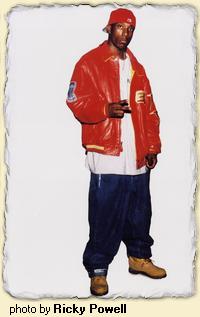 BIG L
BIG L
A member of Fat Joe's DITC crew, rapper Big L was born Lamont Coleman on May 30, 1974. He made his solo debut with 1995's Lifestylez Ov Da Poor & Dangerous, scoring a series of underground hits including "No Endz, No Skinz," "Street Struck" and "Da Graveyard"; Big L's best-known effort, the single "Ebonics," followed on his own Flamboyant label in the summer of 1998. Around the same time, he joined the Bronx-based hip-hop supergroup DITC (Diggin' in the Crates), appearing on their single, "Dignified Soldiers." On the evening of February 15, 1999, Big L was shot and killed just blocks away from his Harlem home; he was just 24 at the time of his death. Both the DITC album Worldwide and the second Big L solo effort, The Big Picture, followed in 2000.
|
|
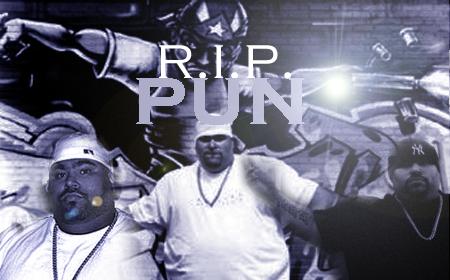 Big Punisher
Big Punisher was a Bronx-based hardcore rapper who earned a solid underground reputation in the late '90s by appearing on records by his mentor Fat Joe, Raekwon and the Beatnuts. Born Christopher Rios, he signed to Loud Records, a division of RCA, in 1997, and a massive publicity campaign was launched to promote him. Stickers, posters, advertisements and fliers boasting his "Big Pun" logo were circulated in large cities, getting his name out to the appropriate circles. Before his debut album was released, his "I'm Not a Player" single was an underground hit, and he hosted Rap City's Soul in the Hole television special. His debut, Capital Punishment, was finally released in the spring of 1998. It featured a number of guest rappers and big-name producers, including the TrackMasters, the Beatnuts, RZA, Show Biz, B-Real, Inspectah Deck, Wyclef Jean, Kool G Rap, Noreaga and Busta Rhymes. In the fall of 1999, Big Pun teamed with a number of fellow Latino rappers, including Fat Joe, to form the Terror Squad, issuing a self-titled LP on Atlantic. The 700-pound rapper died of a heart attack on February 7, 2000; he was just 28 years old. The posthumous Yeeeah Baby appeared a few weeks later.
|
 Contemporary R&B singer Aaliyah (born Aaliyah Haughton) became an overnight sensation in 1994 with her debut album, Age Ain't Nothing But a Number, and its two hit singles, "Back and Forth" and "At Your Best (You Are Love)." Born in Brooklyn but raised in Detroit, she was influenced by an entertainment background  her mother was a singer, her uncle an entertainment lawyer once married to Gladys Knight. She appeared in concert with Knight at the age of 11, and released her first album just four years later. Paced by the Top Ten hits "Back & Forth" and "At Your Best (You Are Love)" (the latter an Isley Brothers cover), 1994's Age Ain't Nothing But a Number became a multi-platinum smash. She endured controversy near the end of the year, however, when news broke of her marriage at the age of 15 to her producer, R. Kelly.
After severing her ties with Kelly, Aaliyah resurfaced in 1996 with her second album, One in a Million. Collaborating with rising production stars Timbaland and Missy Misdemeanor Elliott, Aaliyah pointed the way for the minimalist hip-hop of the late '90s with hits like "One in a Million" and "If Your Girl Only Knew." By the end of the decade, she'd made the move to film, starring in Romeo Must Die with Jet Li and agreeing to appear in the projected pair of sequels to The Matrix. Just one month after her self-titled third album appeared in 2001, though, she died in a private-plane crash while returning from a video shoot in the Bahamas.
|
|
|
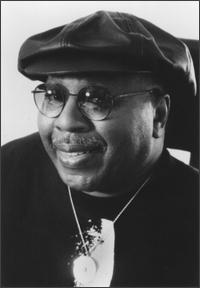 Biography
Perhaps because he didn't cross over to the pop audience as heavily as Motown's stars, it may be that the scope of Curtis Mayfield's talents and contributions have yet to be fully recognized. Judged merely by his records alone, the man's legacy is enormous. As the leader of the Impressions, he recorded some of the finest soul vocal group music of the 1960s. As a solo artist in the 1970s, he helped ... Read More Perhaps because he didn't cross over to the pop audience as heavily as Motown's stars, it may be that the scope of Curtis Mayfield's talents and contributions have yet to be fully recognized. Judged merely by his records alone, the man's legacy is enormous. As the leader of the Impressions, he recorded some of the finest soul vocal group music of the 1960s. As a solo artist in the 1970s, he helped pioneer funk and helped introduce hard-hitting urban commentary into soul music. "Gypsy Woman," "It's All Right," "People Get Ready," "Freddie's Dead," and "Superfly" are merely the most famous of his many hit records.
But Curtis Mayfield wasn't just a singer. He wrote most of his material at a time when that was not the norm for soul performers. He was among the first -- if not the very first -- to speak openly about African-American pride and community struggle in his compositions. As a songwriter and a producer, he was a key architect of Chicago soul, penning material and working on sessions by notable Windy City soulsters like Gene Chandler, Jerry Butler, Major Lance, and Billy Butler. In this sense, he can be compared to Smokey Robinson, who also managed to find time to write and produce many classics for other soul stars. Mayfield was also an excellent guitarist, and his rolling, Latin-influenced lines were highlights of the Impressions' recordings in the '60s. During the next decade, he would toughen up his guitar work and production, incorporating some of the best features of psychedelic rock and funk.
Mayfield began his career as an associate of Jerry Butler, with whom he formed the Impressions in the late '50s. After the Impressions had a big hit in 1958 with "For Your Precious Love," Butler, who had sung lead on the record, split to start a solo career. Mayfield, while keeping the Impressions together, continued to write for and tour with Butler before the Impressions got their first Top 20 hit in 1961, "Gypsy Woman."
Mayfield was heavily steeped in gospel music before he entered the pop arena, and gospel, as well as doo wop, influences would figure prominently in most of his '60s work. Mayfield wasn't a staunch traditionalist, however. He and the Impressions may have often worked the call-and-response gospel style, but his songs (romantic and otherwise) were often veiled or unveiled messages of black pride, reflecting the increased confidence and self-determination of the African-American community. Musically he was an innovator as well, using arrangements that employed the punchy, blaring horns and Latin-influenced rhythms that came to be trademark flourishes of Chicago soul. As the staff producer for the OKeh label, Mayfield was also instrumental in lending his talents to the work of other Chi-town soul singers who went on to national success. With Mayfield singing lead and playing guitar, the Impressions had 14 Top 40 hits in the 1960s (five made the Top 20 in 1964 alone), and released some above-average albums during that period as well.
Given Mayfield's prodigious talents, it was perhaps inevitable that he would eventually leave the Impressions to begin a solo career, as he did in 1970. His first few singles boasted a harder, more funk-driven sound; singles like "(Don't Worry) If There's a Hell Below, We're All Gonna Go" found him confronting ghetto life with a realism that had rarely been heard on record. He really didn't hit his artistic or commercial stride as a solo artist, though, until Superfly, his soundtrack to a 1972 blaxploitation film. Drug deals, ghetto shootings, the death of young black men before their time: all were described in penetrating detail. Yet Mayfield's irrepressible falsetto vocals, uplifting melodies, and fabulous funk pop arrangements gave the oft-moralizing material a graceful strength that few others could have achieved. For all the glory of his past work, Superfly stands as his crowning achievement, not to mention a much-needed counterpoint to the sensationalistic portrayals of the film itself.
At this point Mayfield, along with Stevie Wonder and Marvin Gaye, was the foremost exponent of a new level of compelling auteurism in soul. His failure to maintain the standards of Superfly qualifies as one of the great disappointments in the history of black popular music. Perhaps he'd simply reached his peak after a long climb, but the rest of his '70s work didn't match the musical brilliance and lyrical subtleties of Superfly, although he had a few large R&B hits in a much more conventional vein, such as "Kung Fu," "So in Love," and "Only You Babe."
Mayfield had a couple of hits in the early '80s, but the decade generally found his commercial fortunes in a steady downward spiral, despite some intermittent albums. On August 14, 1990, he became paralyzed from the neck down when a lighting rig fell on top of him at a concert in Brooklyn, NY. In the mid-'90s, a couple of tribute albums consisting of Mayfield covers appeared, with contributions by such superstars as Eric Clapton, Bruce Springsteen, and Gladys Knight. Though no substitute for the man himself, these tributes served as an indication of the enormous regard in which Mayfield was still held by his peers. He died December 26, 1999 at the age of 57.
|
|
 Biography
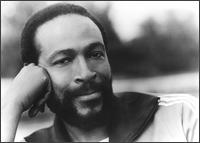
One of the most gifted, visionary, and enduring talents ever launched into orbit by the Motown hit machine, the career of Marvin Gaye blazed the trail for the continued evolution of popular black music: moving from lean, powerful R&B to stylish, sophisticated soul to finally arrive at an intensely political and personal form of artistic self-expression, his work not only redefined soul music as a creative ... Read More One of the most gifted, visionary, and enduring talents ever launched into orbit by the Motown hit machine, the career of Marvin Gaye blazed the trail for the continued evolution of popular black music: moving from lean, powerful R&B to stylish, sophisticated soul to finally arrive at an intensely political and personal form of artistic self-expression, his work not only redefined soul music as a creative force but also expanded its impact as an agent for social change.
Marvin Pentz Gay, Jr. (in the style of his hero Sam Cooke, he added the "e" to his surname as an adult) was born April 2, 1939 in Washington, D.C. The second of three children born to Marvin Sr., an ordained minister in the House of God -- a conservative Christian sect fusing elements of orthodox Judaism and Pentecostalism which imposes strict codes of conduct and observes no holidays -- he began singing in church at the age of three, quickly becoming a soloist in the choir. Later taking up piano and drums, music became Gaye's escape from the nightmarish realities of his home life -- throughout his childhood, his father beat him on an almost daily basis.
After graduating high school, Gaye enlisted in the U.S. Air Force; upon his discharge, he returned to Washington and began singing in a number of street-corner doo wop groups, eventually joining the Rainbows, a top local attraction. With the help of mentor Bo Diddley, the Rainbows cut "Wyatt Earp," a single for the Okeh label which brought them to the attention of singer Harvey Fuqua, who in 1958 recruited the group to become the latest edition of his backing ensemble, the Moonglows. After relocating to Chicago, the Moonglows recorded a series of singles for Chess including 1959's "Mama Loocie"; while touring the Midwest, the group performed in Detroit, where Gaye's graceful tenor and three-octave vocal range won the interest of fledgling impressario Berry Gordy Jr., who signed him to the Motown label in 1961.
While first working at Motown as a session drummer and playing on early hits by Smokey Robinson and the Miracles, he met Gordy's sister Anna, and married her in late 1961. Upon mounting a solo career, Gaye struggled to find his voice, and early singles failed; finally, his fourth effort, "Stubborn Kind of Fellow," became a minor hit in 1962, and his next two singles -- the 1963 dance efforts "Hitch Hike" and "Can I Get a Witness" -- both reached the Top 30. With 1963's "Pride and Joy," Gaye scored his first Top Ten smash, but often found his role as a hitmaker stifling -- his desire to become a crooner of lush romantic ballads ran in direct opposition to Motown's all-important emphasis on chart success, and the ongoing battle between his artistic ambitions and the label's demands for commercial product continued throughout Gaye's long tenure with the company.
With 1964's Together, a collection of duets with Mary Wells, Gaye scored his first charting album; the duo also notched a number of hit singles together, including "Once Upon a Time" and "What's the Matter With You, Baby?" As a solo performer, Gaye continued to enjoy great success, scoring three superb Top Ten hits -- "Ain't That Peculiar," "I'll Be Doggone," and "How Sweet It Is (To Be Loved by You)" -- in 1965. In total, he scored some 39 Top 40 singles for Motown, many of which he also wrote and arranged; with Kim Weston, the second of his crucial vocal partners, he also established himself as one of the era's dominant duet singers with the stunning "It Takes Two."
However, Gaye's greatest duets were with Tammi Terrell, with whom he scored a series of massive hits penned by the team of Nickolas Ashford and Valerie Simpson, including 1967's "Ain't No Mountain High Enough" and "Your Precious Love," followed by 1968's "Ain't Nothing Like the Real Thing" and "You're All I Need to Get By." The team's success was tragically cut short in 1967 when, during a concert appearance in Virginia, Terrell collapsed into Gaye's arms onstage, the first evidence of a brain tumor which abruptly ended her performing career and finally killed her on March 16, 1970. Her illness and eventual loss left Gaye deeply shaken, marring the chart-topping 1968 success of "I Heard It Through the Grapevine," his biggest hit and arguably the pinnacle of the Motown Sound.
At the same time, Gaye was forced to cope with a number of other personal problems, not the least of which was his crumbling marriage. He also found the material he recorded for Motown to be increasingly irrelevant in the face of the tremendous social changes sweeping the nation, and after scoring a pair of 1969 Top Ten hits with "Too Busy Thinking About My Baby" and "That's the Way Love Is," he spent the majority of 1970 in seclusion, resurfacing early the next year with the self-produced What's Going On, a landmark effort heralding a dramatic shift in both content and style which forever altered the face of black music. A highly percussive album which incorporated jazz and classical elements to forge a remarkably sophisticated and fluid soul sound, What's Going On was a conceptual masterpiece which brought Gaye's deeply held spiritual beliefs to the fore to explore issues ranging from poverty and discrimination to the environment, drug abuse and political corruption; chief among the record's concerns was the conflict in Vietnam, as Gaye structured the songs around the point of view of his brother Frankie, himself a soldier recently returned from combat.
The ambitions and complexity of What's Going On baffled Berry Gordy, who initially refused to release the LP; he finally relented, although he maintained that he never understood the record's full scope. Gaye was vindicated when the majestic title track reached the number two spot in 1971, and both of the follow-ups, "Mercy Mercy Me (The Ecology)" and "Inner City Blues (Make Me Wanna Holler)," also reached the Top Ten; the album's success guaranteed Gaye continued artistic control over his work and helped loosen the reins for other Motown artists, most notably Stevie Wonder, to also take command of their own destinies. Consequently, in 1972, Gaye changed directions again, agreeing to score the blaxploitation thriller Trouble Man; the resulting soundtrack was a primarily instrumental effort showcasing his increasing interest in jazz, although a vocal turn on the moody, minimalist title track scored another Top Ten smash.
The long-simmering eroticism implicit in much of Gaye's work reached its boiling point with 1973's Let's Get It On, one of the most sexually charged albums ever recorded; a work of intense lust and longing, it became the most commercially successful effort of his career, and the title cut became his second number one hit. Let's Get It On also marked another significant shift in Gaye's lyrical outlook, moving him from the political arena to a deeply personal, even insular stance which continued to define his subsequent work. After teaming with Diana Ross for the 1973 duet collection Marvin and Diana, he returned to work on his next solo effort, I Want You; however, the record's completion was delayed by his 1975 divorce from Anna Gordy. The dissolution of his marriage threw Gaye into a tailspin, and he spent much of the mid-1970s in divorce court; to combat Gaye's absence from the studio, Motown released the 1977 stopgap Live at the London Palladium, which spawned the single "Got to Give It Up (Pt. 1)," his final number one hit.
As a result of a 1976 court settlement, Gaye was ordered to make good on missed alimony payments by recording a new album, with the intention that all royalties earned from its sales would then be awarded to his ex-wife. The 1978 record, a two-LP set sardonically titled Here, My Dear, bitterly explored the couple's relationship in such intimate detail that Anna Gordy briefly considered suing Gaye for invasion of privacy. In the interim, he had remarried and begun work on another album, Lover Man, but scrapped the project when the lead single "Ego Tripping Out" -- a telling personal commentary presented as a duet between the spiritual and sexual halves of his identity, which biographer David Ritz later dubbed the singer's "divided soul" -- failed to chart. As his drug problems increased and his marriage to new wife Janis also began to fail, he relocated to Hawaii in an attempt to sort out his personal affairs.
In 1981, long-standing tax difficulties and renewed pressures from the I.R.S. forced Gaye to flee to Europe, where he began work on the ambitious In Our Lifetime, a deeply philosophical record which ultimately severed his long-standing relationship with Motown after he claimed the label had remixed and edited the album without his consent; additionally, Gaye stated that the finished artwork parodied his original intent, and that even the title had been changed to drop an all-important question mark. Upon signing with Columbia in 1982, he battled stories of erratic behavior and a consuming addiction to cocaine to emerge triumphant with Midnight Love, an assured comeback highlighted by the luminous Top Three hit "Sexual Healing." The record made Gaye a star yet again, and in 1983 he made peace with Berry Gordy by appearing on a television special celebrating Motown's silver anniversary. That same year, he also sang a soulful and idiosyncratic rendition of "The Star-Spangled Banner" at the NBA All-Star Game which instantly became one of the most controversial and legendary interpretations of the anthem ever performed; it was to be his final public appearance.
Gaye's career resurgence brought with it an increased reliance on cocaine; finally, his personal demons forced him back to the U.S., where he moved in with his parents in an attempt to regain control of his life. Tragically, the return home only exacerbated his spiral into depression; he and his father quarrelled bitterly, and Gaye threatened suicide on a number of occasions. Finally, on the afternoon of April 1, 1984 -- one day before his 45th birthday -- Gaye was shot and killed by the Reverend Marvin Gay, Sr. in the aftermath of a heated argument. In the wake of his death, Motown and Columbia teamed to issue two 1985 collections of outtakes, Dream of a Lifetime -- a compilation of erotic funk workouts teamed with spiritual ballads -- and the big-band inspired Romantically Yours. (Vulnerable, a collection of ballads which took over 12 years to complete, finally saw release in 1996.) With Gaye's death also came a critical re-evaluation of his work, which deemed What's Going On to be one of the landmark albums in pop history, and his 1987 induction into the Rock and Roll Hall of Fame permanently enshrined him among the pantheon of musical greats.
|
 Biography
Reggae's most transcendent and iconic figure, Bob Marley was the first Jamaican artist to achieve international superstardom, in the process introducing the music of his native island nation to the far-flung corners of the globe. Marley's music gave voice to the day-to-day struggles of the Jamaican experience, vividly capturing not only the plight of the country's impoverished and oppressed but also ... Read More Reggae's most transcendent and iconic figure, Bob Marley was the first Jamaican artist to achieve international superstardom, in the process introducing the music of his native island nation to the far-flung corners of the globe. Marley's music gave voice to the day-to-day struggles of the Jamaican experience, vividly capturing not only the plight of the country's impoverished and oppressed but also the devout spirituality which remains their source of strength. His songs of faith, devotion and revolution created a legacy which continues to live on not only through the music of his extended family but also through generations of artists the world over touched by his genius. Robert Nesta Marley was born February 6, 1945 in rural St. Ann's Parish, Jamaica; the son of a middle-aged white father and teenaged black mother, he left home at 14 to pursue a music career in Kingston, becoming a pupil of local singer and devout Rastafarian Joe Higgs. He cut his first single "Judge Not" in 1962 for Leslie Kong, severing ties with the famed producer soon after over a monetary dispute.
In 1963 Marley teamed with fellow singers Peter Tosh, Bunny Livingstone, Junior Braithwaite, Beverly Kelso and Cherry Smith to form the vocal group the Teenagers; later rechristened The Wailing Rudeboys and later simply the Wailers, they signed on with producer Coxsone Dodd's legendary Studio One and recorded their debut "I'm Still Waiting." When Braithwaite and Smith exited the Wailers, Marley assumed lead vocal duties, and in early 1964 the group's follow-up "Simmer Down" topped the Jamaican charts. A series of singles including "Let Him Go (Rude Boy Get Gail), " "Dancing Shoes, " "Jerk in Time, " "Who Feels It Knows It" and "What Am I to Do" followed, and in all, the Wailers recorded some 70 tracks for Dodd before disbanding in 1966. On February 10 of that year, Marley married Rita Anderson, a singer in the group the Soulettes; she later enjoyed success as a member of the vocal trio the I-Threes. Marley then spent the better part of the year working in a factory in Newark, DE, the home of his mother since 1963.
Upon returning to Jamaica that October, Marley reformed the Wailers with Livingstone and Tosh, releasing "Bend Down Low" on their own short-lived Wail 'N' Soul 'M label; at this time all three members began devoting themselves to the teachings of the Rastafari faith, a cornerstone of Marley's life and music until his death. Beginning in 1968, the Wailers recorded a wealth of new material for producer Danny Sims before teaming the following year with producer Lee "Scratch" Perry; backed by Perry's house band the Upsetters, the trio cut a number of classics, including "My Cup, " "Duppy Conqueror, " "Soul Almighty" and "Small Axe, " which fused powerful vocals, ingenious rhythms and visionary production to lay the groundwork for much of the Jamaican music in its wake. Upsetters bassist Aston "Family Man" Barrett and his drummer brother Carlton soon joined the Wailers full-time, and in 1971 the group founded another independent label, Tuff Gong, releasing a handful of singles before signing to Chris Blackwell's Island Records a year later.
1973's Catch a Fire, the Wailers' Island debut, was the first of their albums released outside of Jamaica, and immediately earned worldwide acclaim; the follow-up, Burnin', launched the track "I Shot the Sheriff, " a Top Ten hit for Eric Clapton in 1974. With the Wailers poised for stardom, however, both Livingstone and Tosh quit the group to pursue solo careers; Marley then brought in the I-Threes, which in addition to Rita Marley consisted of singers Marcia Griffiths and Judy Mowatt. The new line-up proceeded to tour the world prior to releasing their 1975 breakthrough album Natty Dread, scoring their first UK Top 40 hit with the classic "No Woman, No Cry." Sellout shows at the London Lyceum, where Marley played to racially-mixed crowds, yielded the superb Live! later that year, and with the success of 1976's Rastaman Vibration, which hit the Top Ten in the U.S., it became increasingly clear that his music had carved its own niche within the pop mainstream.
As great as Marley's fame had grown outside of Jamaica, at home he was viewed as a figure of almost mystical proportions, a poet and prophet whose every word had the nation's collective ear. His power was perceived as a threat in some quarters, and on December 3, 1976 he was wounded in an assassination attempt; the ordeal forced Marley to leave Jamaica for over a year. 1977's Exodus was his biggest record to date, generating the hits "Jamming, " "Waiting in Vain" and "One Love/People Get Ready"; Kaya was another smash, highlighted by the gorgeous "Is This Love" and "Satisfy My Soul." Another classic live date, Babylon by Bus, preceded the release of 1979's Survival. 1980 loomed as Marley's biggest year yet, kicked off by a concert in the newly-liberated Zimbabwe; a tour of the U.S. was announced, but while jogging in New York's Central Park he collapsed, and it was discovered he suffered from cancer which had spread to his brain, lungs and liver. Uprising was the final album released in Marley's lifetime -- he died May 11, 1981 at age 36.
Posthumous efforts including 1983's Redemption and the best-selling 1984 retrospective Legend kept Marley's music alive, and his renown continued growing in the years following his death -- even decades after the fact, he remains synonymous with reggae's worldwide popularity. In the wake of her husband's passing Rita Marley scored a solo hit with "One Draw, " but despite the subsequent success of the singles "Many Are Called" and "Play Play, " by the mid-1980 she largely withdrew from performing to focus on raising her children. Oldest son David, better known as Ziggy, went on to score considerable pop success as the leader of the Melody Makers, a Marley family group comprised of siblings Cedelia, Stephen and Sharon; their 1988 single "Tomorrow People" was a Top 40 U.S. hit, a feat even Bob himself never accomplished. Three other Marley children -- Damian, Julian and Ky-Mani -- pursued careers in music as well.
|
|
|
|
|
|
|
|
|
|
|
|
|
|
|
|
|
|
|
|
|
|
|
|
|
|
|
|
|
|
|
|
|
|
|

|
|

|


|
|


